Whether you’re a beginner learning how to change direction with confidence or an advanced athlete wanting to sharpen your quickness, these supportive drills can help you feel more in control of your body and your game.
Throughout this inclusive guide, we’ll explore what Speed Agility Drills are, why they matter, how they can support your training journey, and how you can incorporate them into your tennis practice or everyday fitness routine.
We will also walk through three positive and approachable speed drills— the T-Drill, the H-Drill, and the 25-Yard Sprint—along with recommended work-to-rest ratios, progressions from beginner to professional levels, and helpful accessories.
What Are Speed Agility Drills?
Speed Agility Drills are structured movement exercises designed to help individuals improve their ability to accelerate, decelerate, and change direction efficiently and safely. Often used in tennis, soccer, basketball, and fitness training, these drills enhance an athlete’s responsiveness, footwork quality, and body control. They may also be referred to as:
- agility footwork drills
- quick-movement exercises
- reaction-speed drills
- multi-directional training
No matter what you call them, the purpose of these drills is to help movers of all levels feel more balanced and confident as they transition from one movement to another. Because they are customizable and modifiable, Speed Agility Drills can support anyone—from beginners learning foundational positioning to advanced athletes practicing complex change-of-direction patterns.
Why Practice Speed Agility Drills?
There are many reasons athletes and active individuals incorporate Speed Agility Drills into their routines. First and foremost, they help improve coordination and reaction time in a gentle yet effective way. Additionally, they help condition the muscles, joints, and nervous system to respond quickly and efficiently during dynamic movement.
Some of the most uplifting benefits include:
- Enhanced balance and stability, especially during quick transitions.
- Improved reaction speed, making on-court decisions feel more intuitive.
- Better footwork efficiency, supporting smoother and more precise movement.
- Stronger neuromuscular coordination, which is essential for safe directional changes.
- Increased confidence through skill development and controlled movement practice.
- Injury prevention, as agility training strengthens stabilizing muscles and enhances body awareness.
Because these drills emphasize intentional, controlled patterns, they are welcoming to individuals who want to build movement skills step-by-step. This makes agility training a supportive and empowering part of any fitness journey.
Types of Speed Agility Drills
There are many varieties of Speed Agility Drills, and each type emphasizes slightly different skills. Some focus on lateral movement, others on forward acceleration, backward transitions, or reactive decision-making. Common types include:
- Lateral movement drills – such as side-steps, shuffle patterns, and slide steps.
- Linear speed drills – including sprints, quick accelerations, and stop-and-go patterns.
- Multi-directional drills – for practicing forward, lateral, diagonal, and backward transitions.
- Reaction-based drills – using visual or audible cues to improve response time.
- Footwork pattern drills – practiced with speed ladders, cones, or rings.
In this article, we will focus on three welcoming and effective footwork patterns: the T-Drill, the H-Drill, and the 25-Yard Sprint. These drills help athletes explore a variety of directional changes while building confidence and flow.
Speed Agility Drills: The T-Agility Drill

The T-Agility Drill features a movement path shaped like a “T,” supporting athletes as they practice lateral shuffles, controlled landings, acceleration, and backpedaling. This drill is accessible for all levels, and its straightforward structure helps individuals feel steady and supported as they develop quick-change control.
How to Set Up the T-Drill
To create a friendly and motivational setup:
- Place two agility rings at the center of the baseline—these mark your split-step zone.
- Set one agility ring on the deuce-court sideline and one on the ad-court sideline.
- Add two more rings near the net, creating a forward-movement endpoint.
How to Perform the T-Agility Drill
- Begin by landing a balanced split-step at the center rings.
- Move sideways to the right in a smooth side-step pattern and land inside the ring.
- Stick the landing softly on one foot, promoting balance and control.
- Push off and transition to the opposite sideline using the same side-step pattern.
- Land on one foot again, staying mindful of stability and alignment.
- Return to the center, then accelerate forward to the rings near the net.
- Jump into the final set of rings with soft knees and stable posture.
- Backpedal safely and quickly to move beyond the baseline.
This gentle yet dynamic pattern encourages full-body engagement and supports both strength and coordination in a positive, approachable way.
Speed Agility Drills: The H-Drill
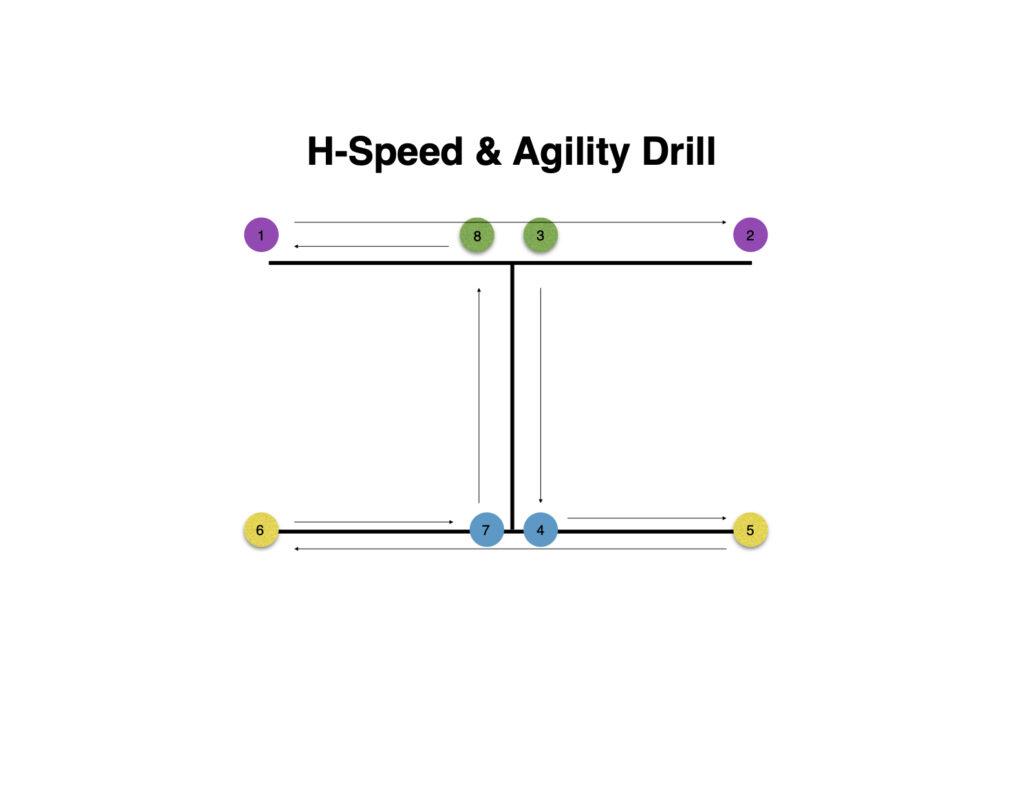
The H-Drill, named for its “H-shaped” court mapping, is an excellent all-court agility exercise that mirrors the natural patterns athletes often use in tennis. Because it blends forward, lateral, and diagonal movements, the H-Drill helps athletes grow comfortable moving across multiple planes at once.
How to Set Up the H-Drill
To create the “H,” arrange agility rings or cones at:
- the center of the baseline (split-step point),
- both sidelines near the service line,
- and two corresponding points closer to the net.
How to Perform the H-Drill
- Begin with a gentle split-step in the middle of the baseline.
- Move diagonally to the right, landing with control.
- Transition forward toward the net to continue the “H” pattern.
- Shift laterally across the front part of the H.
- Move backward on a diagonal to return to the baseline.
- Repeat the full sequence on the opposite side.
Because it mimics realistic court movement, the H-Drill helps athletes cultivate confidence, rhythm, timing, and body awareness. Even beginners can start slowly and progress at a pace that feels supportive and encouraging.
Speed Agility Drills: The 25-Yard Sprint Drill
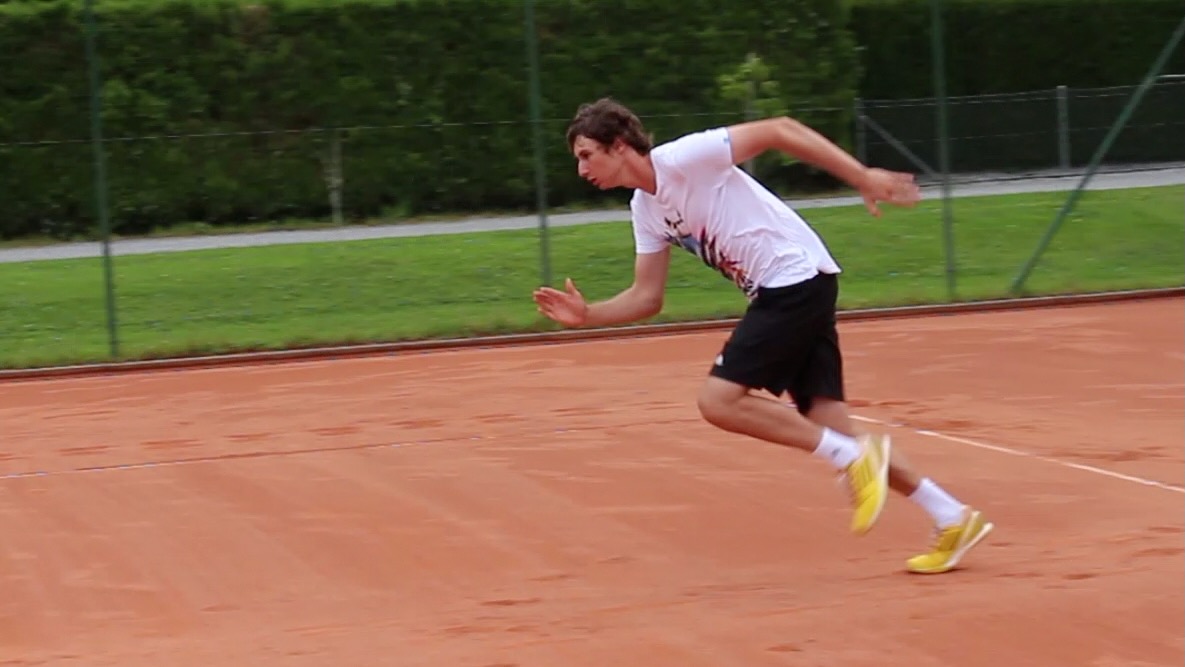
The 25-Yard Sprint Drill is a simple linear speed drill that highlights acceleration, stride efficiency, and quick, confident takeoff. It’s also adaptable—making it friendly for beginners and highly useful for experienced players.
How to Set Up the 25-Yard Sprint
- Mark the starting point with two agility rings on the baseline extension.
- Place two more rings on the far extension of the service line.
- These markers provide clear visual guidance and help athletes stay consistent.
How to Perform the 25-Yard Sprint
- Begin by stepping into the first two rings with a centered split-step.
- Accelerate forward with smooth, controlled strides.
- Finish the sprint by running through the final set of rings.
- Walk back to the starting point and rest appropriately.
Straight-line drills like this one support posture, stride alignment, and the confidence to accelerate under control.
Benefits of Speed Agility Drills
Speed Agility Drills offer a holistic blend of physical and psychological benefits that serve athletes and recreational movers alike. These advantages include:
- Greater movement efficiency through improved foot placement and body alignment.
- Stronger mind-body coordination, leading to smoother reactions and transitions.
- Increased muscular strength and power in the legs, hips, and core.
- Enhanced endurance and stamina due to repeated directional changes.
- Improved sport performance, especially in tennis, where movement variety is essential.
- A sense of empowerment and confidence as athletes master new skills.
These drills help create a foundation for safe, enjoyable movement—both on and off the court.
Speed Agility Drills Recommendations: Reps, Cycles & Rest
To encourage effective, balanced training, it’s important to incorporate supportive rest intervals. A thoughtful work-to-rest ratio helps athletes maintain proper form, avoid overtraining, and build confidence.
A common recommendation is to use a 1:3 to 1:8 work-to-rest ratio. For example:
- If a drill takes 15 seconds to complete, a well-conditioned athlete may rest 45 seconds.
- A beginner may rest 2 minutes (120 seconds) or more, which allows full recovery.
Sample Speed Agility Drills Workout
- Warm-Up: 10 minutes of mobility + dynamic movements
- T-Drill: 3–5 repetitions per cycle
- H-Drill: 3–5 repetitions per cycle
- 25-Yard Sprint: 4–6 repetitions
- Rest: Follow the 1:3–1:8 ratio as appropriate
- Cooldown: 5–10 minutes of gentle stretching
You can adjust these numbers to meet the needs of your athletes, ensuring everyone feels supported and empowered during the session.
Progressions for Speed Ladder Drills
Because many athletes use speed ladders as part of their Speed Agility Drills, here are supportive progressions from beginner to professional level:
- Beginner: Eyes on your feet
It’s completely natural for beginners to look at their feet while learning new patterns. This visual support helps build comfort and familiarity. - Intermediate: Eyes forward during direction changes
Once athletes feel more confident, they practice keeping their eyes forward. This encourages stronger proprioception and greater court awareness. - Advanced/Professional: Following an external cue
Examples include tracking a tennis ball, responding to a coach’s signal, or reacting to a moving visual target. This enhances reactive agility and sport-specific decision-making.
For a deeper look at footwork progressions, explore our related editorial: Speed Ladder Drills: Improve Footwork, Agility, and Confidence.
Accessories for Speed Agility Drills
While speed and agility training can be performed with minimal equipment, many athletes enjoy using accessories that add structure and variety. Popular options include:
- Agility rings
- Agility cones
- Speed ladders
- Resistance bands
- Mini hurdles
- Reaction balls
These tools help create clear pathways for movement and support visual learning while keeping training fun and engaging.
Should You Do Speed Agility Drills Before or After Tennis Training?
Because Speed Agility Drills prepare the nervous system for fast, intentional movement, they are best performed before tennis training—after a gentle warm-up. This ensures:
- your muscles are primed for quick reactions,
- you practice footwork patterns with maximal control,
- you reduce fatigue-related injury risk.
That said, some athletes enjoy performing agility drills after tennis as conditioning work. Choose whichever option feels most supportive for your training goals and energy levels.
To explore additional conditioning ideas, visit: Interval Training for Tennis: An Inclusive Guide.
How to Incorporate Speed Agility Drills Into Your Daily Workout Routine
It’s easy to integrate Speed Agility Drills into your weekly or daily rhythm. Even 10–15 minutes of agility work can make a positive difference in coordination, balance, and confidence. Here are friendly approaches:
- Add agility drills after your warm-up to activate your body before strength training or cardio.
- Use them as a standalone quick workout when you want something energizing but low-impact.
- Pair them with mobility exercises for a supportive and well-rounded session.
- Rotate different drills throughout the week to keep your routine fresh and motivating.
How to Incorporate Speed Agility Drills Into Your Tennis Training
Agility work can blend naturally with tennis training sessions. Consider incorporating the drills:
- Before hitting sessions to warm up your movement pathways.
- Between rally segments to build endurance and reactivity.
- As footwork-focused mini-workouts during off-court training days.
- Alongside technical practice—for instance, combining an agility drill with a forehand or volley sequence.
For inspiration on professional-level tennis movement, explore this internal link: Alexander Ritschard Professional Tennis Training: Footwork Insights.