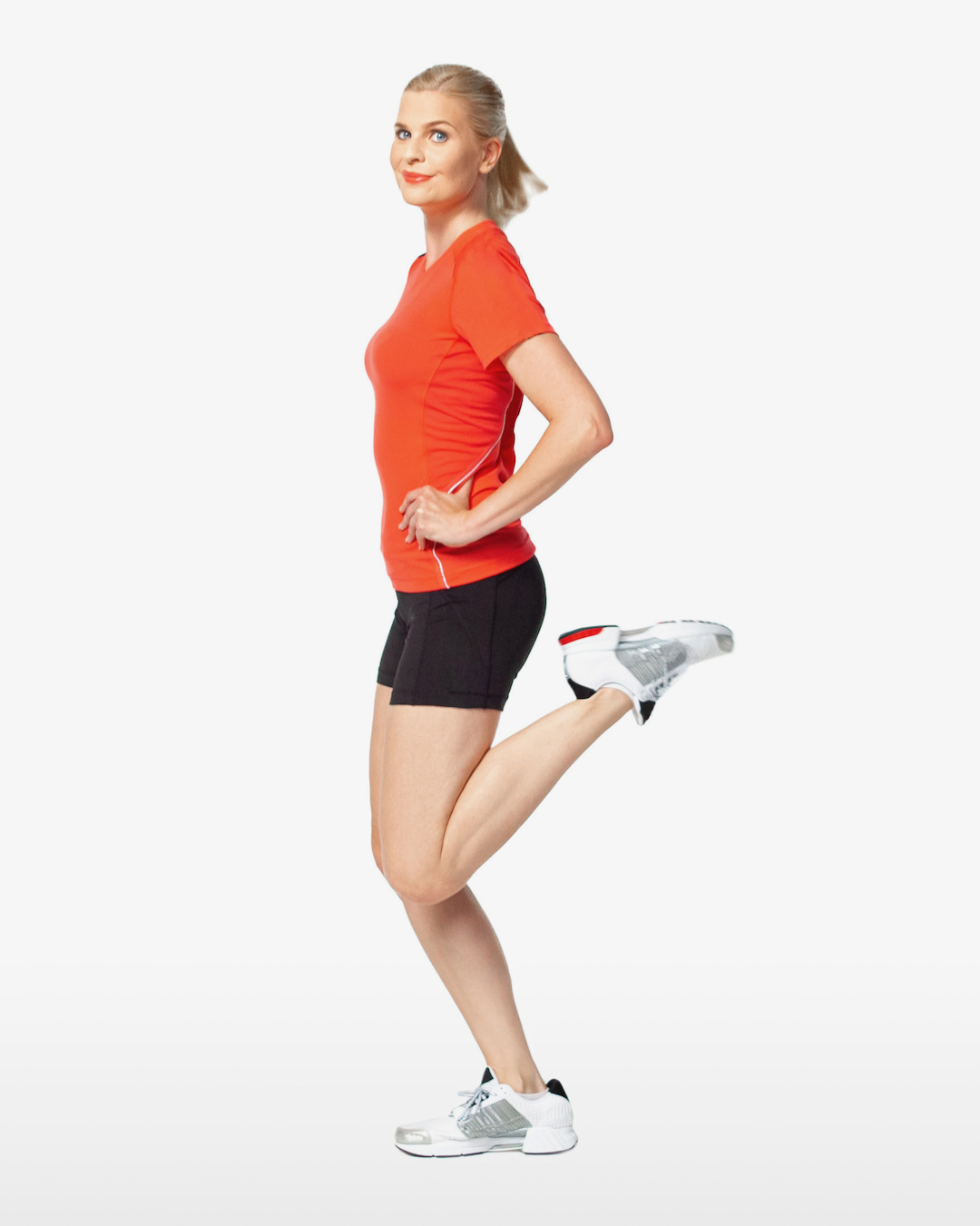
Why Include Buttocks Kicks In Your Routine?
First, Buttocks Kicks prepare the quadriceps and hip flexors for activity; therefore, they help improve readiness for explosive movements. Moreover, because the quads play a role in running and jumping, including this dynamic quad stretch can support safer performance and better hip and quad mobility.
Additionally, Buttocks Kicks are accessible and scalable, so they fit into group warm-ups, individual training, and inclusive coaching settings.
Buttocks Kicks — Step-by-Step
- Stand facing forward with weight evenly distributed.
- Keep knees and feet approximately under the shoulders.
- Slowly lift one heel toward your buttocks, aiming to feel a comfortable stretch in the front of the thigh — this is the Buttocks Kick (a classic butt kicks exercise cue).
- Lower with control and repeat, alternating legs.
- Maintain a neutral pelvis and upright torso throughout; breathe steadily.
Coaching note: Move with control through a full range of motion for about 10 repetitions per leg to begin, and adjust based on how you feel. This dynamic movement is best used as part of tennis warm-up drills or a broader dynamic warm-up.
Buttocks Kicks Muscles Worked?
Primary: Quadriceps (rectus femoris, vastus lateralis, vastus medialis, vastus intermedius).
Secondary: Hip flexors, hamstrings (isometrically), and glute stabilizers.
Therefore, Buttocks Kicks are a focused dynamic quad stretch that also supports whole-leg readiness.
What Variations Of The Buttocks Kicks Exist?
You can adapt the butt kicks exercise based on your needs and available equipment:
- No equipment: alternating kicks while standing in place.
- Walking Buttocks Kicks: forward steps while performing heel-to-butt strikes; a great way to add coordination.
- Resistance band-assisted: a light loop band around the ankles or mid-thighs to encourage hip stability.
- Weighted/cable variation (advanced): ankle strap on a low cable for progressive resistance when technique is solid.
- Assisted options: use a stable support to reduce load and focus on rhythm (great for rehab or beginners).
Use Of Resistance Bands Or Other Accessories
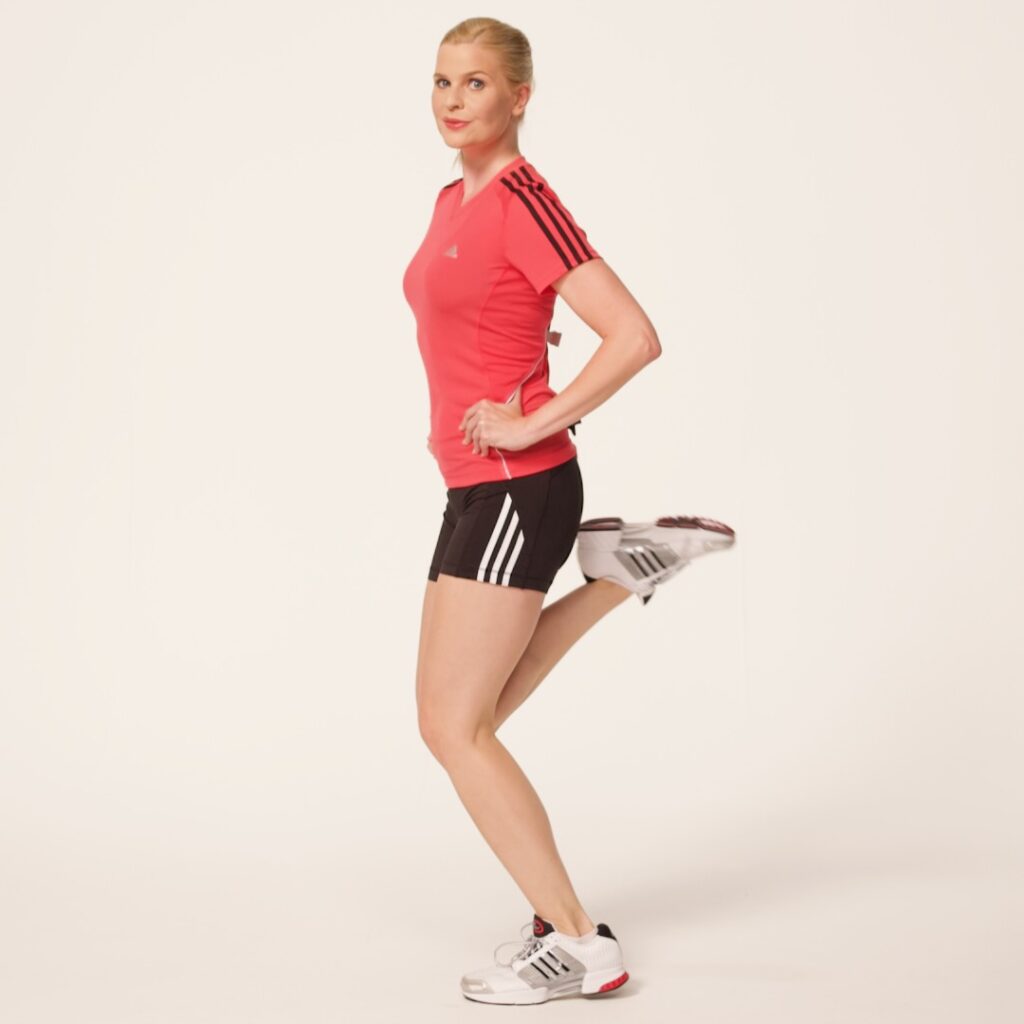
Resistance bands add gentle, progressive tension and challenge hip stability. Start with a light loop and progress only when control and posture remain solid. Other helpful accessories include an ankle strap for cable work or small hurdles for coordination drills.
What Are Possible Progressions Of The Buttocks Kicks From Beginners To Professional Athletes?
Beginner: Seated or supported Buttocks Kicks, 8–10 reps per leg, focus on neutral pelvis.
Novice: Standing Buttocks Kicks in place, 10–12 reps per leg; integrate into a 6–8 exercise dynamic routine that targets legs, hips, and core.
Intermediate: Walking Buttocks Kicks with light resistance band, 2–3 sets of 10–15 reps to enhance hip and quad mobility and motor control.
Advanced/Professional: Fast-paced Buttocks Kicks within a high-intensity warm-up circuit, paired with accelerations and plyometrics, and optionally light cable resistance.
Always prioritize form: if technique falters, scale back to protect joints and optimize benefit.
How Many Reps And Timing?
Aim for 10 repetitions per leg as a baseline, performed in a controlled manner. When included in sport-specific warm-ups, Buttocks Kicks fit into 6–8 dynamic exercises totaling 6–12 minutes.
Safety And Injury Prevention
Include Buttocks Kicks as part of a balanced warm-up to support strength and flexibility. If you have a current knee or hip concern, consult a healthcare professional before progressing. For general medical guidance, see Mayo Clinic.
More Dynamic Stretches and Resources
For more warm-up options, try these: